- Summary
- Building a robust interpreter from scratch requires mastering fundamental logic, starting with building a lexer to tokenize inputs efficiently. Next, construct a parser that translates tokens into a precise Abstract Syntax Tree (AST) to capture the syntactic structure clearly. To deepen understanding, explore how closures function within the recursive descent parser architecture to explain how these closures interact with the tree. Additionally, compare external discussion on built-in data structures with the practical implementation of Pratt parsing. Finally, understand how the REPL stands for Real-Time Execution and learn how to build one yourself to grasp the language in context.
This journey is deeply engaging, offering the ability to study how a favorite interpreted language works while maintaining a hobbyist mindset. It encourages looking under the hood to appreciate complexity. By focusing on code and learning joy through programming, one can appreciate the intricacies of compiler design without getting lost in heavy theory. This approach caters to those interested in compilers and interpreters who prefer practical code over theoretical explanations, allowing them to start early with a C-like language. - Title
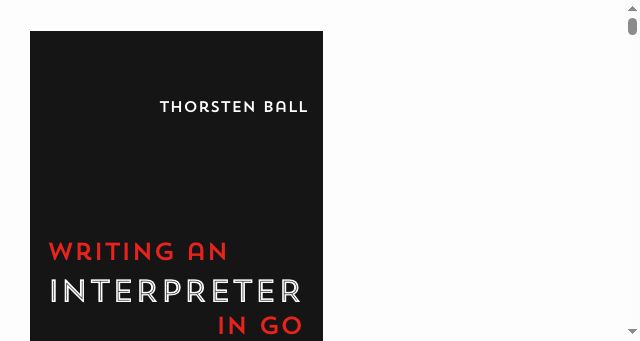
- Writing An Interpreter In Go | Thorsten Ball
- Description
- This book takes you from 0 lines of code to a fully working interpreter for the Monkey programming language. Step by step. All code shown and included. Fully unit tested.
- Keywords
- book, interpreter, code, monkey, writing, language, programming, books, read, working, compiler, have, compilers, interpreters, function, name, chapter
- Categories
- NS Lookup
- A 18.208.88.157, A 98.84.224.111
- Dates
-
Created 2026-02-14Updated 2026-02-14Summarized 2026-03-22
Screenshot
Query time: 2710 ms